What a device's last reported location can tell you
Read device location evidence accurately: freshness, spatial accuracy, unanswered requests, history gaps and geofence events.
A location pin answers a narrower question than it first appears to: where did this device report a position, and when? For an IT team, the useful decision comes from combining that observation with its age, available accuracy and the device's reporting state.
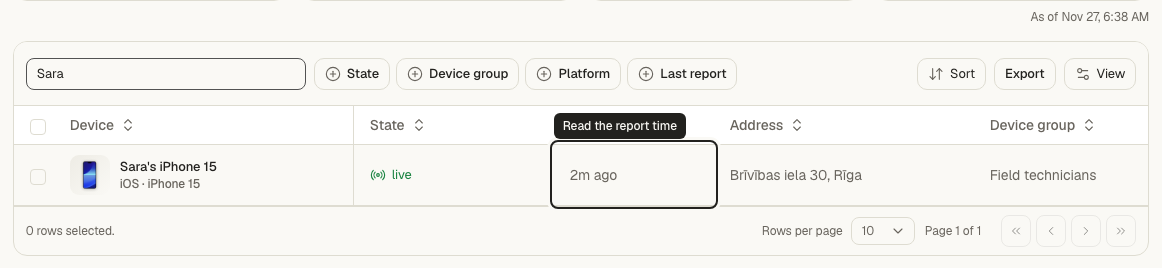
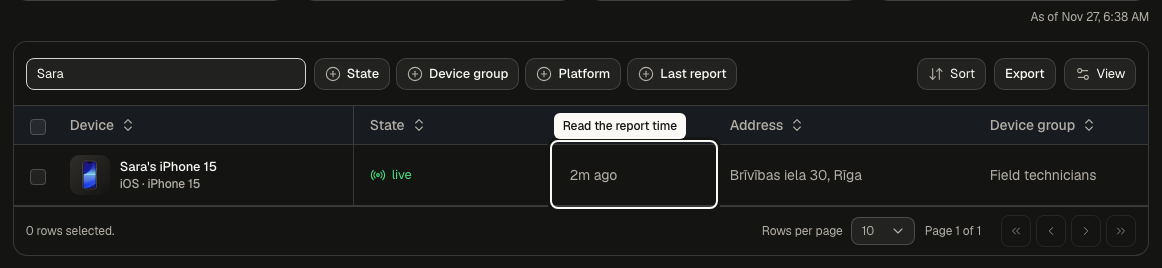
That distinction matters when a warehouse tablet is missing at a shift change, a field device has stopped checking in, or a retail branch reports that an asset is at the wrong site. The same pin can be useful historical evidence in one case and too old to guide an immediate action in another.
Start with the observation, not the map
Read four things together: device identity, report time, position and available accuracy.
The device identifier protects against confusing similarly named assets. The report time establishes the age of the observation. The coordinates describe the selected position; an address is a readable label for that position. Accuracy helps you judge whether the measurement can distinguish the places relevant to your decision.
The map is a way to read that information, not a replacement for it. A well-rendered pin does not make an old report current. Conversely, a map-rendering problem does not necessarily mean that the textual coordinates and timestamp are unavailable.
Keep freshness and precision separate
Freshness is temporal. Accuracy is spatial. Improving one does not automatically improve the other.
Consider a hypothetical investigation at 14:20, with all times expressed in the same time zone:
| Observation | What it supports | What remains uncertain |
|---|---|---|
| Report at 14:18 with usable site-level accuracy | The device supplied a recent observation at the reported position | Where it moved after 14:18 |
| Report at 09:00 with a narrow accuracy value | A more precise historical observation | Whether it is still there hours later |
| Report at 14:18 with broad accuracy | A recent observation in a less precise area | Which nearby building or side of a small boundary it occupied |
| No report | No location conclusion from this record | Whether collection is off, unsupported, pending or otherwise unavailable |
These examples are decision aids, not promises about the freshness or accuracy of a particular platform.
Use the product's displayed reporting state as a triage cue, then read the underlying timestamp. The label Recent can be useful in a fleet list while still being insufficient for an immediate missing-device response.
Separate observation time from investigation time
A relative timestamp loses meaning when copied without context. “Two minutes ago” refers to the moment someone viewed the page, not a permanent point in an incident timeline.
When retaining evidence, record the absolute report timestamp, its time zone and the time you inspected it. Compare report and event times in a consistent zone. If those values appear inconsistent, resolve the discrepancy before drawing a movement conclusion.
A console refresh asks the interface to retrieve or present its available information. It does not, by itself, establish that the device produced a new position. Check whether the reporting timestamp advanced.
Use Locate now as a request-and-observe workflow
An on-demand request is useful when a newer observation would change the next action and the device supports the request.
Before selecting Locate now, retain the current report time. After submission, read the request state, any device answer and the available position.
There are three separate questions:
- Was the request accepted or otherwise processed to the stage shown?
- Did the device answer, and did that answer contain a position or a reason that none was available?
- Did a newer captured position become available?
A positive answer to the first does not establish the second or third. A repeated observation may be handled without adding a new stored fix, and a device can answer without a position. A later recorded-position timestamp demonstrates a newer captured observation; an unchanged timestamp alone does not prove that the request was unanswered. The earlier position remains historical evidence until a newer useful observation is available. Repeated submissions do not justify relabeling it as current.
Check effective reporting controls, device availability and capability before retrying. Preserve the last available evidence if the case needs escalation.
Do not turn point history into a continuous route
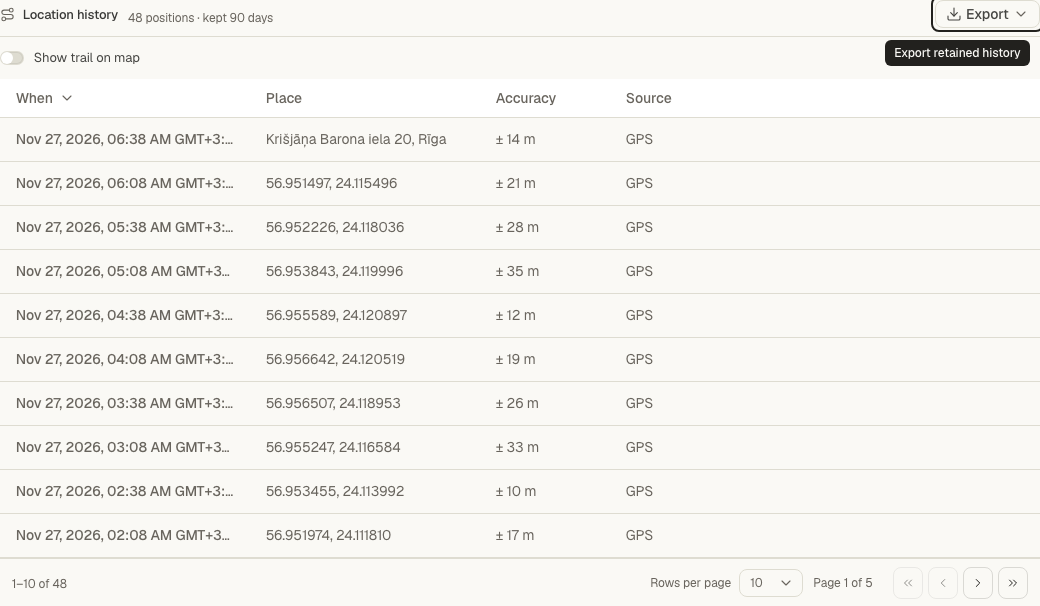
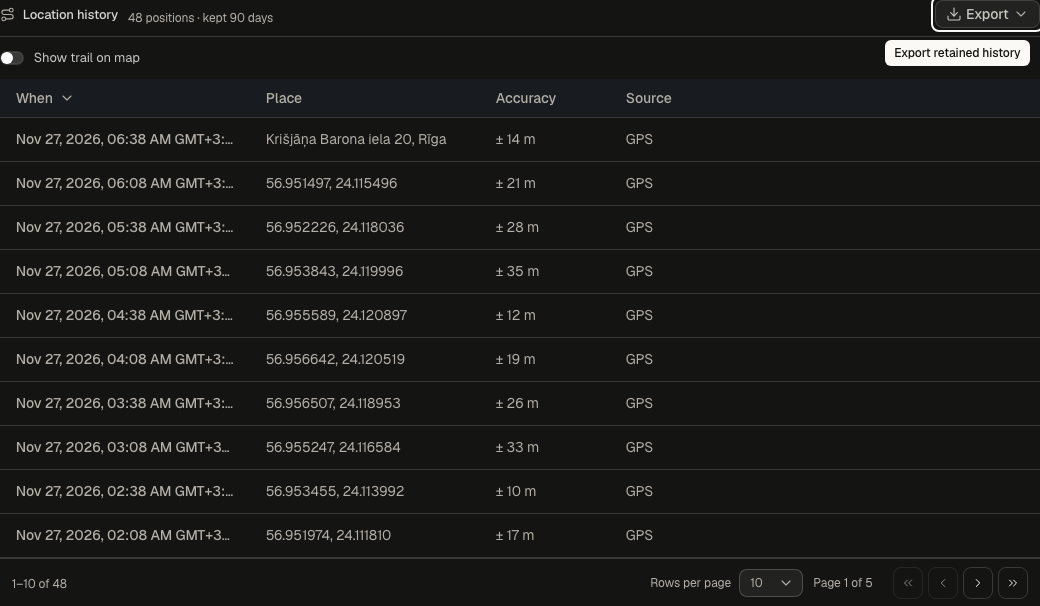
Location history contains recorded observations. A displayed trail can make their order easier to read, but a straight line between two points does not prove that the device travelled along that exact line.
Likewise, a gap between reports is not evidence that the device stayed in place. Nor does a jump between reports establish an exact departure time, speed or route.
For a field-service case, history may help identify the last reporting area worth checking. It cannot replace communication with the assigned team or an approved recovery procedure. Keep the physical safety decision separate from the location interpretation.
Read geofence activity as its own evidence
An entry or exit record has a device, a boundary, a direction and an associated time. It may also show the position associated with the event. Read those values as one event.
Do not substitute the latest device position for the event's position. The device may have reported again after the boundary activity being investigated.
A geofence event also does not prove that a notification reached an operator or that a Zero Trust access policy made a particular decision. Verify delivery or access-control evidence in the relevant workflow.
Apply the interpretation to three operational scenarios
Warehouse: find the next useful handoff check
A shared tablet is missing from its charging station. Start by identifying the exact asset and checking its last report. If the observation is recent and useful for the site-level question, coordinate a safe physical check through the warehouse process.
If a boundary event exists, inspect its time and direction. Use it to focus the investigation, not to identify a person or establish a complete chain of custody. Confirm the handoff with the shift's operational records.
Field operations: retain evidence while a device is unreachable
A technician reports a missing company device. Retain the last report and request another only if the action is available. If no new observation arrives, preserve the distinction between “request submitted” and “device answered.”
Use the applicable recovery controls and the service desk's escalation path. A recovery action's submission and its confirmed device state should also be recorded separately.
Retail: explain a branch discrepancy before changing policy
A device appears at a different branch from the one expected. Verify the device identity, report age, address and available accuracy before modifying a blueprint or reporting setting.
The discrepancy may involve an old observation or an asset-assignment issue. Changing collection scope without first retaining the evidence can make the original question harder to explain.
Write a defensible incident note
Prefer a statement that preserves the observation:
At 14:20, the device record showed a last report timestamp of 14:18 in the displayed time zone. The reported position was associated with the warehouse site. A new location request was submitted; no later report had been observed when the case was handed over.
Avoid shortening that into “the device is at the warehouse” or “the request located it” unless the additional conclusion is independently supported.
Share only the detail the recipient needs. A status update may not require exact coordinates, historical points or an export.
For the product's field and capability model, see Geolocation availability and data.